
For a 10,000mAh vs 20,000mAh power bank decision, choose by the no-outlet window you actually face, the devices that must last through it, and the weight you will willingly carry every day.
10,000mAh vs 20,000mAh power bank: quick answer
Choose 10,000mAh for normal commuting, event days, or a single phone where pocket and bag weight matter. Move to 20,000mAh when you repeatedly finish long days, travel between outlets, or share power with another compatible device. Both selected options have 30W output; the larger one buys capacity, not a guarantee that every laptop routine will work.
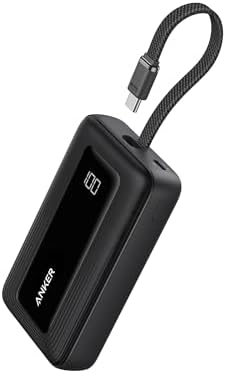
Daily-carry path: a compact 30W bank for one phone or a small USB-C routine.
Anker Zolo Power Bank 10,000mAh 30W
$29.99

Long-day path: more stored energy when the extra carried weight has a real job.
Anker Zolo Power Bank 20,000mAh 30W
$42.99
Disclosure: As an Amazon Associate I may earn from qualifying purchases.
Start with the no-outlet window
Do not start with the largest number on the box. Start with the time you cannot reach a dependable outlet: a commute plus workday, a concert and ride home, a travel day, or several days between reliable charging. Then name the devices that must make it through that window. A phone-only routine is different from a phone plus tablet, handheld console, or second person’s phone.
If the bank stays in a jacket pocket, small cross-body bag, or compact work bag, its size and weight are part of the answer. A higher-capacity bank that stays at home cannot solve the day you actually have.
When 10,000mAh is the better daily carry
Choose the selected 10,000mAh Anker Zolo when the job is one maintained phone or a small compatible USB-C routine through an ordinary long day. The checked listing states 30W maximum output, a built-in USB-C cable, USB-C and USB-A ports, dimensions of 4.32 by 2.58 by 0.98 inches, and a listed weight of 0.47 lb. That is the better direction when carrying comfort is a recurring constraint.
It is not a promise of a fixed number of charges. Real delivered energy changes with the phone, battery condition, cable, heat, and the way the bank and device negotiate charging. Treat a smaller bank as the practical default when you can recharge it most nights and the day rarely contains a second heavy no-outlet stretch.
When 20,000mAh earns its extra bulk
Choose the selected 20,000mAh Anker Zolo when a longer no-outlet window is normal, another compatible device regularly joins the load, or you would rather have capacity margin than a smaller bag. The checked listing states the same 30W maximum output and built-in USB-C cable, with a 4.72 by 2.89 by 1.23 inch body and a listed weight of 12.45 ounces.
The tradeoff is simple: it carries materially more energy, but also more weight and volume. It makes sense for a long travel day, a weekend away from dependable outlets, or a shared routine. It is unnecessary ballast when the usual problem is only a single phone falling short late in the afternoon.
Same output does not make the two routines identical
Both selected listings describe 30W output. That helps keep the comparison about capacity and carried weight rather than pretending that one is automatically faster. A 30W maximum is still not a blanket compatibility claim for every laptop, cable, or multi-device setup. Check the device input requirement, its cable, and whether the bank divides output when more than one device is connected.
For a laptop travel question, separate the lack-of-outlet problem from the charging-at-an-outlet problem. A wall charger can be the more useful purchase when outlets exist but a shared charging setup is the failure.
Keep 5,000mAh, flight rules, and daily carry separate
A 5,000mAh magnetic bank can make sense as a slim phone-only bridge. It is not the same choice as a wired daily-carry bank. Flight rules are also a different question: check the watt-hour label on the exact bank and your carrier’s current policy before packing, especially if a carry-on could be gate checked. Capacity in mAh alone does not settle the airline rule.
Before buying
- Write down the longest normal time without an outlet, not the most dramatic trip you might take once.
- Name every device that must share the bank and the cable each one actually uses.
- Put the approximate size and weight into the pocket or bag where it will live.
- Verify the exact Amazon listing’s selected variant, included cable, price, and availability at checkout.
- For flights, read the label in watt-hours and the current airline rule separately.
Related buying guides
- 5,000mAh magnetic power bank for a slim phone-only backup
- Power-bank flight limits: check watt-hours and carry-on placement
- Laptop travel power: power bank or wall charger first?
Traveling with an Apple Watch? Once a 10,000mAh bank covers the capacity you actually need, decide whether the Watch charger is the component worth integrating in the one-bank versus separate-charger guide.
FAQ
- Is 20,000mAh always better?
No. It is better only when the longer no-outlet window or additional device load is real enough to justify carrying a larger bank every day. - Will either bank charge every USB-C laptop?
No. Confirm the laptop’s input needs, cable, and the exact power bank’s output behavior before relying on it. - Should I use mAh alone to decide if it can fly?
No. Check the watt-hour label on the exact bank and the current policy for the airline and itinerary.