
A power bank can be small enough for an everyday phone bag and still create an airport problem if its label is unreadable, it is packed in the wrong bag, or the carrier has a stricter policy than the general rule. Start with the exact battery in your hand: identify its watt-hour marking, keep it with you in the cabin, and check the airline’s current rule before you pack.
Quick answer
For a U.S. passenger flight, the FAA says spare lithium batteries, including power banks and portable chargers, must be carried in carry-on baggage, not checked. A battery rated 0-100 Wh is allowed; 101-160 Wh needs the air carrier’s approval and is limited to two spare batteries; batteries above 160 Wh are forbidden.
Do the label check before you decide what to buy or pack
| What you can verify | What it changes | Next action |
|---|---|---|
| The product label clearly states 0-100 Wh | It fits the FAA’s general allowance band for a spare lithium battery. | Keep it in carry-on baggage and confirm the carrier’s live policy. |
| The label states 101-160 Wh | The FAA says air-carrier approval is required and limits the traveler to two spare batteries. | Get the carrier’s approval before travel; do not assume a familiar brand or capacity is enough. |
| The label is missing, worn, or cannot be read | You cannot safely treat a marketing mAh number as the whole packing answer. | Find the exact product documentation or choose a clearly labeled battery after checking the carrier rule. |
| The battery is damaged or recalled | It is not an ordinary packing question. | Use the FAA and carrier guidance instead of taking it to the airport as a routine spare. |
Why mAh alone does not settle the flight question
Power-bank listings often foreground mAh because it is familiar to shoppers. Flight limits are expressed in watt-hours. The FAA explains that, when the Wh rating is not printed, it can be calculated from volts multiplied by amp-hours; mAh must first be divided by 1,000. That calculation is a fallback for identifying the battery, not permission to ignore the carrier’s own current limits, quantity rules, or instructions for a gate-checked carry-on.
Pack it for the moment your carry-on is taken at the gate
- Read the exact product label before leaving home and photograph it only if that helps you identify the same item later.
- Put spare batteries and power banks where they remain with you in the aircraft cabin, not in checked luggage.
- If a carry-on is checked at the gate or planeside, remove spare lithium batteries and keep them with you in the cabin.
- Open the specific carrier’s current dangerous-goods or battery policy before departure, especially for international travel or a battery above 100 Wh.
- Do not use a brand name, a generic “airline approved” claim, or a product category as a substitute for the exact label and carrier policy.
Two everyday backup paths to inspect after the packing decision
These are documented price snapshots from existing S2 guides. They are ordinary carry backup options, not airline approval claims. Confirm the exact product label, selected listing, your current phone or laptop setup, and the airline’s policy before buying or flying.
Disclosure: As an Amazon Associate I may earn from qualifying purchases. Prices, stock, and delivery terms can change — please confirm the current details on Amazon before ordering.

For an ordinary phone-or-light-laptop backup routine after the label and carrier rule are checked
Anker Nano Power Bank 10000mAh 30W
$49.99
For a small current-phone backup, not as evidence that every phone, case, or flight rule is the same
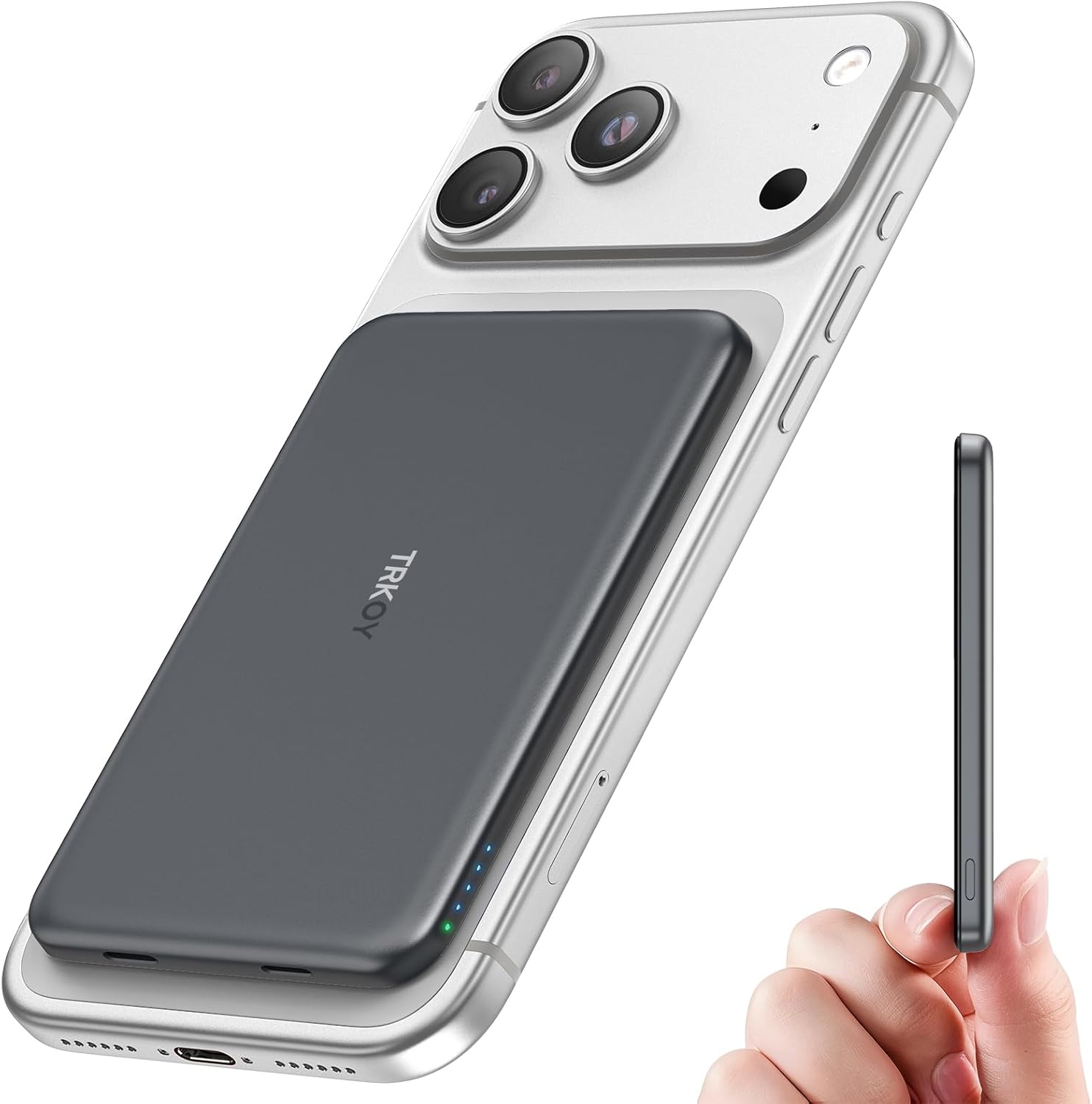
TRKOY W5 5000mAh Slim Wireless Magnetic Power Bank
$19.99 $30.62
Do not confuse a phone power bank with a home-power solution
A compact battery can be useful for an ordinary phone, tablet, or light USB-C backup routine. It is not a substitute for a power station, an outage plan, airline approval, or a safety decision. The correct product category follows the job: a flight packing question starts with the battery label and carrier policy; a home outage question starts with the devices, food, medical needs, and local official information.
FAQ
- Q: Can I put a power bank in checked luggage?
A: No. The FAA says spare lithium batteries, including power banks and portable chargers, must be carried on, not checked. - Q: Is a 10,000mAh power bank automatically allowed?
A: Do not decide from mAh alone. Check the exact battery’s Wh label and the carrier’s current policy. - Q: Do I need airline approval for every power bank?
A: The FAA’s general rule allows 0-100 Wh; 101-160 Wh requires air-carrier approval. Airlines may have stricter quantity or Wh limits, so check the specific carrier before travel. - Q: What if my carry-on is gate checked?
A: Remove spare lithium batteries and keep them with you in the cabin, then follow the carrier’s instructions.